
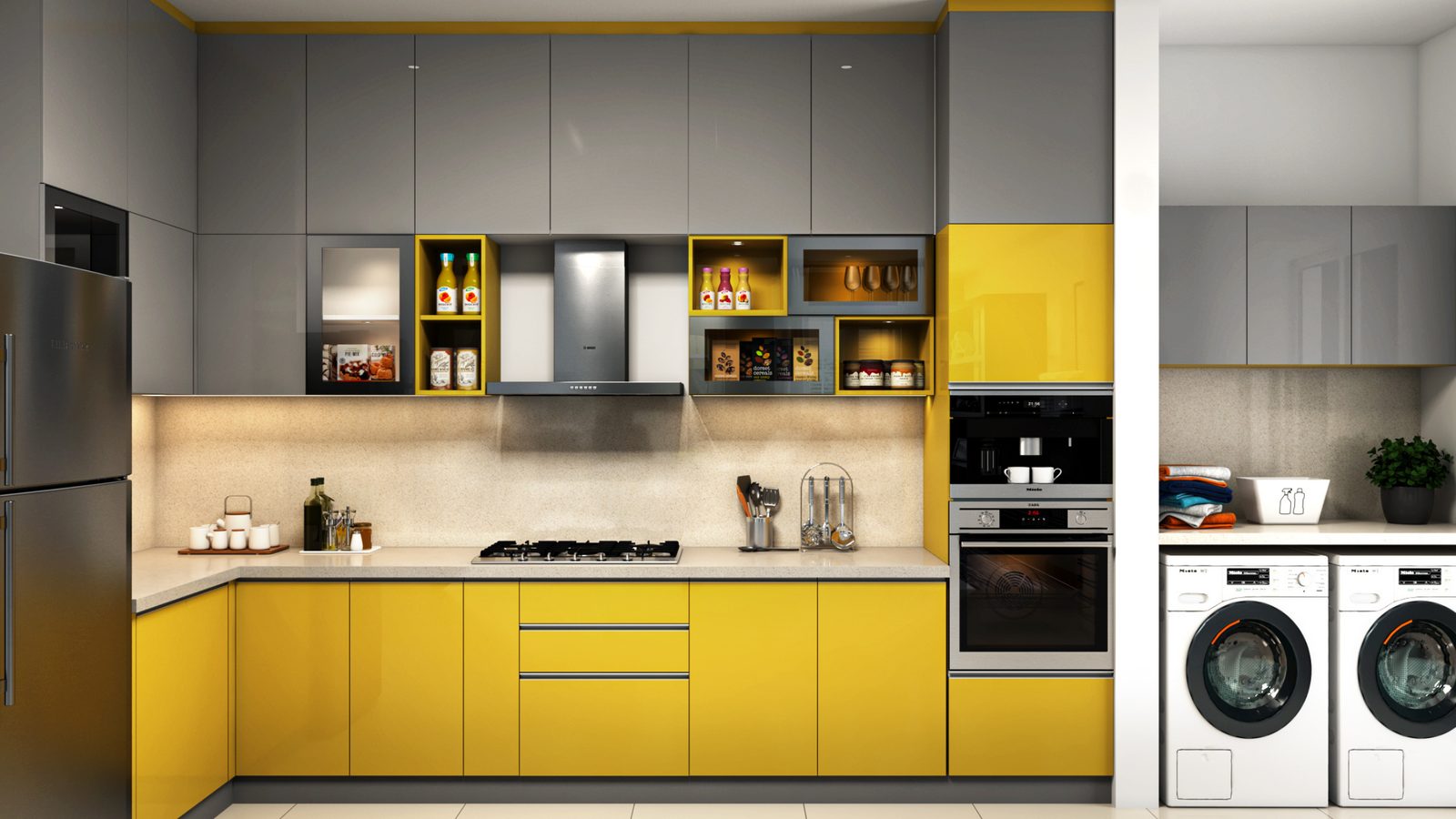
Quick answer: For a typical Indian kitchen, look for chimney suction power of about 1,000 to 1,200 m³/hr, and 1,200 to 1,400 m³/hr if your kitchen is large, open-plan or you deep-fry often. The room-size formula (kitchen volume × 10 to 12) gives a much smaller number, around 300 m³/hr for a 3 × 3 × 3 m kitchen. Brands recommend more because the box rating is measured with no duct attached, and real suction drops once the chimney is installed.
Key takeaways
- Start with the formula: length × width × height in metres, times 10 to 12 air changes an hour.
- Kaff says a chimney rated 1,000 m³/hr may deliver only 600 to 700 m³/hr once installed.
- Match the hood width to your hob: 60 cm for a standard 60 cm stove, 90 cm for a wider one.
- A short, straight 6-inch duct with fewer than three bends matters as much as the number on the box.
In this article, you’ll learn:
- What chimney suction power means
- The 2-minute maths for your kitchen
- Why brands recommend far more than the formula
- How duct, width and height change real performance
- Filters, auto-clean and rough prices
What Chimney Suction Power Means
Chimney suction power is how much air a chimney can pull in an hour, measured in cubic metres per hour (m³/hr). A 1,200 m³/hr chimney can, in theory, move 1,200 cubic metres of air through its filter every hour.
Indian cooking needs that pull. Tadkas, deep frying and roasting masala send up oily smoke that settles on cabinets and walls if the chimney can’t catch it. That’s why chimney suction power is the first number most people compare.
But it’s a lab number. How much of it you get depends on your duct, your kitchen and how the chimney is fitted.
The Formula: Your Kitchen Volume × Air Changes
Both brand guides we read use the same method. Measure your kitchen’s length, width and height in metres, multiply them to get the volume, then multiply by the number of times you want the air replaced each hour.
- Wonderchef’s buying guide uses volume × 10 as the minimum, and × 12 to 15 for heavy Indian frying.
- Kaff’s size guide multiplies by 12, saying air should cycle 10 to 12 times an hour.
Here’s what that gives for some common kitchen sizes, using a 2.7 m ceiling.
| Kitchen (L × W) | Volume | × 10 | × 12 | × 15 (heavy frying) |
|---|---|---|---|---|
| 2.4 × 1.8 m (small flat) | 11.7 m³ | 117 m³/hr | 140 m³/hr | 175 m³/hr |
| 3 × 2.5 m | 20.3 m³ | 203 m³/hr | 243 m³/hr | 304 m³/hr |
| 3 × 4 m | 32.4 m³ | 324 m³/hr | 389 m³/hr | 486 m³/hr |
| 4 × 5 m (open plan) | 54 m³ | 540 m³/hr | 648 m³/hr | 810 m³/hr |
Those numbers look small next to the chimney suction power printed on the box, usually 1,200 or 1,400. There’s a good reason for the gap.
Why Brands Say 1,000 m³/hr or More
Kaff explains this in its piece on the truth about chimney suction capacity. Suction ratings are measured in “free air”, with no duct, bends or outlet cap attached. Once installed, the same chimney works against all of that resistance.
Its example: a chimney rated 1,000 m³/hr may deliver only 600 to 700 m³/hr in a real kitchen. A 1,200 m³/hr unit might deliver about 800. Kaff also notes that brands test differently, so ratings aren’t perfectly comparable between brands.
So the recommendations climb:
| Situation | Suggested suction (rated) | Source |
|---|---|---|
| Kitchen under 100 sq ft | 1,000 to 1,200 m³/hr | Kaff |
| Larger or open-plan kitchen | 1,200 to 1,400 m³/hr | Kaff |
| High-rise flat with shared shaft | Add about 200 m³/hr | Kaff |
| Regular cooking | Above 1,000 m³/hr | Kaff size guide |
| Deep frying or non-veg | 1,200 m³/hr or more | Kaff size guide |
| Most Indian modular kitchens | 1,200 to 1,400 m³/hr | Wonderchef |
Our take on chimney suction power: use the formula to check you’re not wildly off, then buy in the 1,000 to 1,400 band based on your kitchen size and how much you fry. Paying for 1,600 in a small, closed kitchen with a short duct is usually money better spent on a good installation.
Chimney Suction Power Drops With a Bad Duct
The duct is where a lot of suction gets lost. Kaff’s advice:
- Keep the duct short and straight, with fewer than three bends. Each 90-degree bend adds resistance.
- Use smooth, rigid metal pipe. Corrugated plastic adds turbulence and noise.
- Don’t step down the diameter, for example from 6 inches to 4 inches.
Both brands say powerful chimneys usually need a 6-inch (150 mm) duct. Kaff adds that a sealed kitchen weakens suction, and that opening a window by about an inch can improve performance by 15% or more, because the chimney needs fresh air coming in to replace what it pulls out.
Ductless chimneys, which recirculate air through a carbon filter, are weaker. Kaff says charcoal filters add serious resistance, and Wonderchef says ducted venting is more effective.
Width and Height: The Other Half of the Sizing
Even high chimney suction power can’t catch smoke the hood doesn’t cover.
- Width: Kaff says the hood should be at least as wide as your cooktop. A 60 cm chimney is the minimum for a 60 cm four-burner stove, and a 60 cm chimney over a 90 cm hob “will be virtually useless”. A 90 cm chimney over a 60 cm stove is fine if your cabinets allow it.
- Depth: the canopy should cover at least half of the front burners.
- Height: for gas stoves, Kaff suggests 650 to 750 mm from the burners to the hood, and Wonderchef says 65 to 75 cm. Mounting it higher lets smoke drift away before the fan catches it.
If you’re also weighing gas against induction, our induction cooktop vs gas stove comparison covers running costs. Kaff’s height range for induction is lower, 550 to 650 mm.
Filters, Auto-Clean and Rough Prices
Wonderchef’s guide compares the three filter types you’ll see:
| Filter type | Cleaning | Notes |
|---|---|---|
| Baffle | About monthly, dishwasher safe | Handles oil and grease well |
| Mesh | About weekly | Clogs quickly with heavy Indian cooking |
| Filterless (auto-clean) | Empty the oil tray monthly | No filter to wash |
It recommends baffle or filterless for Indian kitchens. Auto-clean models heat up to melt collected oil, which drains into a removable tray.
For a rough idea of price, Wonderchef’s own guide lists its 60 cm auto-clean chimneys at roughly ₹12,500 for a 1,200 m³/hr baffle model and ₹17,500 to ₹19,000 for 1,400 m³/hr filterless models (as listed on 16 Nov 2026). Prices change often, especially during sales, so check the live store page before you buy. Not sure whether a sale price is real? Our checklist for air fryer deals works just as well for chimneys.
Frequently Asked Questions About Chimney Suction Power
Is 1,000 m³/hr chimney suction power enough?
For a small, closed kitchen with a short duct and normal cooking, Kaff puts it in the right range. If you deep-fry often or have an open kitchen, aim for 1,200 or more.
Is higher suction always better?
No. More airflow usually means more noise, and Kaff says you need a balance so it stays quiet enough to use. Installation affects real performance as much as the rating.
Does a 90 cm chimney have more suction than a 60 cm one?
Not necessarily. Width decides how much of the hob the hood covers, and suction is a separate number. Check both.
Can I fit a chimney without a duct?
Yes, ductless models exist, but both Kaff and Wonderchef say they perform worse than ducted ones. If you can run a duct outside, do it.
Buy the Number, Then Fix the Duct
Do the 2-minute maths so you know your kitchen’s baseline, then pick a chimney in the 1,000 to 1,400 m³/hr range based on size and how much you fry. Match the width to your hob, fit it at the right height, and insist on a short, straight 6-inch duct. That’s what turns the number on the box into a kitchen that doesn’t smell of last night’s tadka.
Save this before you shop the next sale, share it with anyone planning a kitchen makeover, and follow our WhatsApp channel for more kitchen buying guides.