
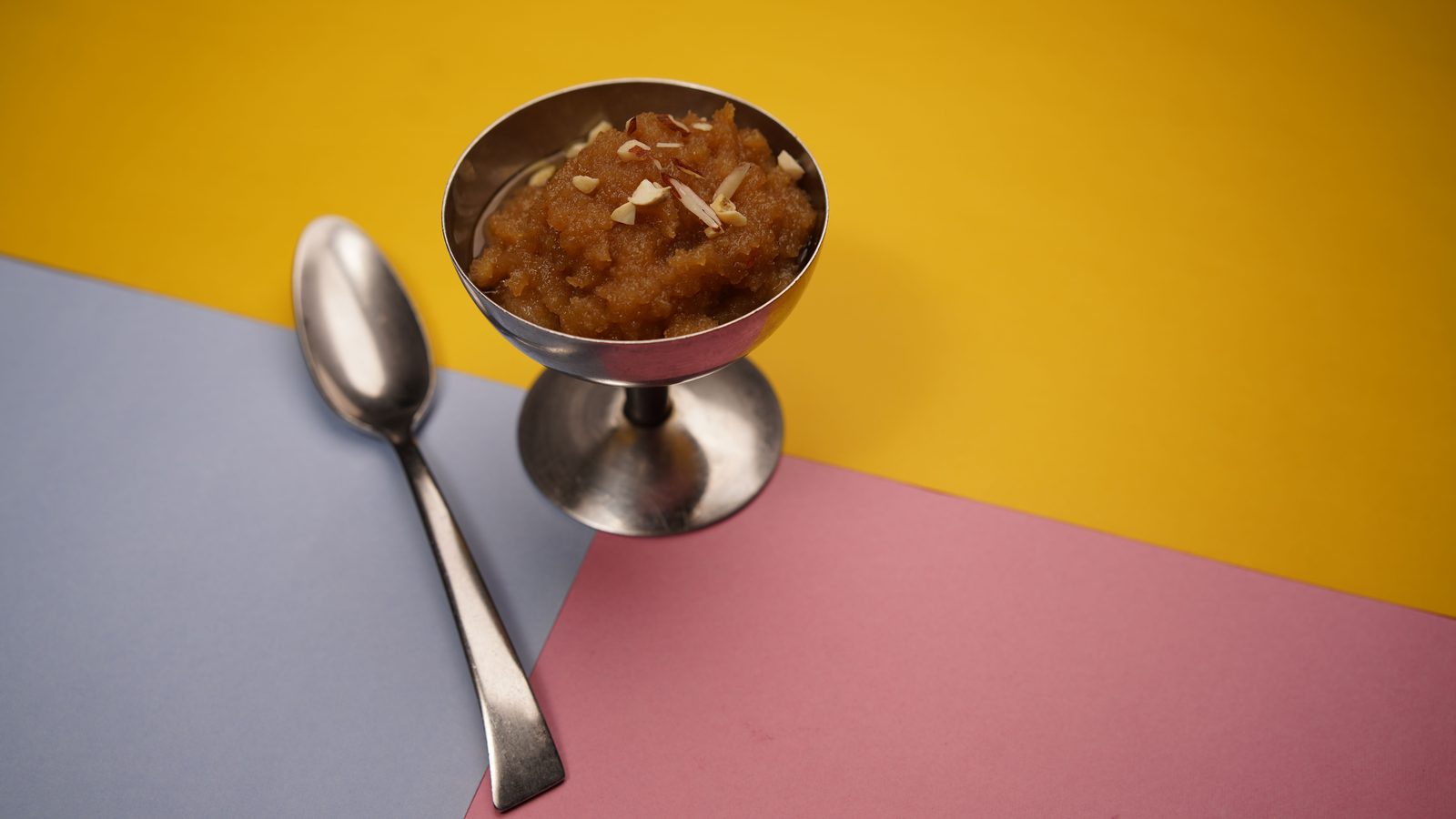
Quick answer: The slow part of moong dal halwa is frying a wet dal paste in ghee until it turns golden. A pressure-cooker method skips that. Dry-roast the dal, pressure cook it with water, mash it, then cook it with ghee and sugar. In one published recipe, that last stirring stage takes about 10 minutes. The halwa is still rich: both recipes we compared use roughly ¾ cup ghee per cup of dal.
Key takeaways
- The classic method soaks and grinds the dal, then fries the paste in ghee. One recipe lists 45 minutes of cooking for half a cup of dal.
- A pressure-cooker recipe dry-roasts the dal for about 10 minutes, pressure cooks it for 12, then needs about 10 minutes of stirring.
- Both recipes use about the same ratio: 12 tablespoons of ghee per cup of dal.
- You can cut the ghee a little, but one recipe warns the halwa gets dense and harder to cook.
In this article, you’ll learn:
- Why moong dal halwa takes so long the classic way
- The pressure-cooker method, step by step
- How much ghee and sugar 2 real recipes use
- How far you can cut the ghee
- How to store and reheat it
Why Moong Dal Halwa Takes So Long
Moong dal halwa is a winter favourite in north India, and it has a reputation. You stand at the kadhai, stirring and scraping, while the dal paste slowly loses its moisture and turns from pale yellow to deep gold.
Swasthi’s Recipes shows the classic way. You rinse ½ cup moong dal, soak it for 30 minutes, grind it slightly coarse, then fry it in ghee on medium and then low heat until it’s deep golden and smells nutty. Only then do milk, water and sugar go in. Her recipe card lists 45 minutes of cooking for 3 to 4 servings.
That time stretches easily. She warns that soaking the dal too long makes it harder to fry and can roughly double the cooking time. Make a bigger batch for guests, and you can see where the “2 hours at the stove” stories come from.
The Pressure-Cooker Moong Dal Halwa Method
Piping Pot Curry makes moong dal halwa a different way, in an Instant Pot. Instead of grinding and frying a wet paste, it roasts the dry dal first and lets pressure do the cooking.
Here’s the method from that recipe, for 1 cup moong dal (6 servings):
- Dry-roast the dal for about 10 minutes, until it turns darker yellow or golden.
- Add 2 cups water, close the lid and pressure cook on high for 12 minutes. Let the pressure drop on its own.
- Mash the dal with a ladle until it’s fairly smooth.
- Add ghee, sugar, cardamom and saffron milk. Stir for about 10 minutes, scraping the bottom, until the ghee starts to separate.
- Top with chopped roasted nuts.
Using a regular stovetop cooker? The recipe’s author says she hasn’t tested it. In reply to a reader, she suggested 2.5 cups water and 3 to 4 whistles. Treat that as a starting point, and check that the dal is soft enough to mash completely. Our guide on pressure cooker whistles explains why whistle counts vary between cookers.
One honest trade-off: the classic halwa gets its grainy, deeply roasted texture from all that frying in ghee. A mashed, pressure-cooked dal won’t turn out exactly the same, so expect a softer halwa.
How Much Ghee and Sugar Do Real Recipes Use?
Here’s how the two recipes compare, scaled to 1 cup of moong dal.
| Classic (Swasthi’s Recipes) | Pressure cooker (Piping Pot Curry) | |
|---|---|---|
| Dal as written | ½ cup, soaked and ground | 1 cup, dry-roasted |
| Ghee as written | 6 tbsp (+2 tbsp optional) | ¾ cup (up to 1 cup) |
| Ghee per cup of dal | 12 tbsp (16 with the optional extra) | 12 tbsp (16 at most) |
| Sugar as written | 6 to 8 tbsp | ¾ cup (up to 1 cup) |
| Liquid | ½ cup water + ½ cup milk | 2 cups water + 3 tbsp milk for saffron |
| Cooking time listed | 45 min | 45 min, but stirring only in the last ~10 |
The total time on both cards is similar. The difference is how much of it you spend stirring. With the cooker, most of that time the dal cooks on its own.
The other thing the table shows: moong dal halwa is a ghee-heavy sweet whichever way you make it. A faster method doesn’t make it lighter.
Can You Use Less Ghee in Moong Dal Halwa?
A little. Swasthi’s recipe says it works with 4 tablespoons of ghee for ½ cup dal instead of 6, but roasting and cooking become much harder and the halwa turns dense. She also says a non-stick pan lets you reduce the ghee and skip the extra 2 tablespoons added at the end.
So a sensible floor is about 8 tablespoons (½ cup) of ghee per cup of dal, in a non-stick pan. Below that, you’re making a different dish.
Sugar is easier to adjust. Both recipes give a range, so start at the low end and taste before adding more. Skipping the khoya also helps. Swasthi’s recipe lists it as optional and says leaving it out shortens the cooking time.
If you want a winter sweet that’s lighter on ghee, our gond ke laddoo with less ghee uses jaggery syrup to do more of the binding.
Tips So It Doesn’t Stick or Turn Lumpy
- Mash the cooked dal well before the ghee goes in. Lumps don’t cook out later.
- Stir on medium-low heat and scrape the bottom often. Sugar catches quickly.
- Add sugar after the dal and ghee have come together, not at the start.
- It’s done when it leaves the sides of the pan and the ghee starts to show at the edges.
- Use a heavy pan or the cooker’s own base, so the bottom doesn’t scorch.
Storing and Reheating
Moong dal halwa firms up as it cools, because the ghee sets. Keep leftovers in a clean, covered box in the fridge. UK Food Standards Agency chilling guidance says fridges should run between 0 and 5°C.
To reheat, warm a portion in a pan with a splash of milk and stir until it loosens and turns glossy again.
Frequently Asked Questions About Moong Dal Halwa
Can I make moong dal halwa in a regular pressure cooker?
Yes, many people do. The Piping Pot Curry author hasn’t tested it, but suggested 2.5 cups water and 3 to 4 whistles for 1 cup dal. Make sure the dal is fully soft before you mash it.
Why does my moong dal halwa stick to the pan?
Usually the heat is too high, or the sugar went in too early. Lower the heat, use a heavy or non-stick pan, and scrape the bottom often.
Should I use whole moong or yellow moong dal?
Both recipes use split yellow moong dal. Whole green moong has a skin and won’t give the same colour or texture.
Is moong dal halwa healthy because it’s made with dal?
Not really. Moong dal adds some protein, but with about ¾ cup ghee and ¾ cup sugar per cup of dal, it’s a rich sweet. Enjoy a small bowl.
A Winter Sweet Without the Sore Arm
The pressure-cooker route won’t make moong dal halwa light. It will give you your evening back. Roast, cook, mash, then stir for the last stretch, and save the long kadhai session for the day you really want that classic texture.
Save this for your next winter craving, share it with whoever makes the family halwa, and follow our WhatsApp channel for more winter recipes.