
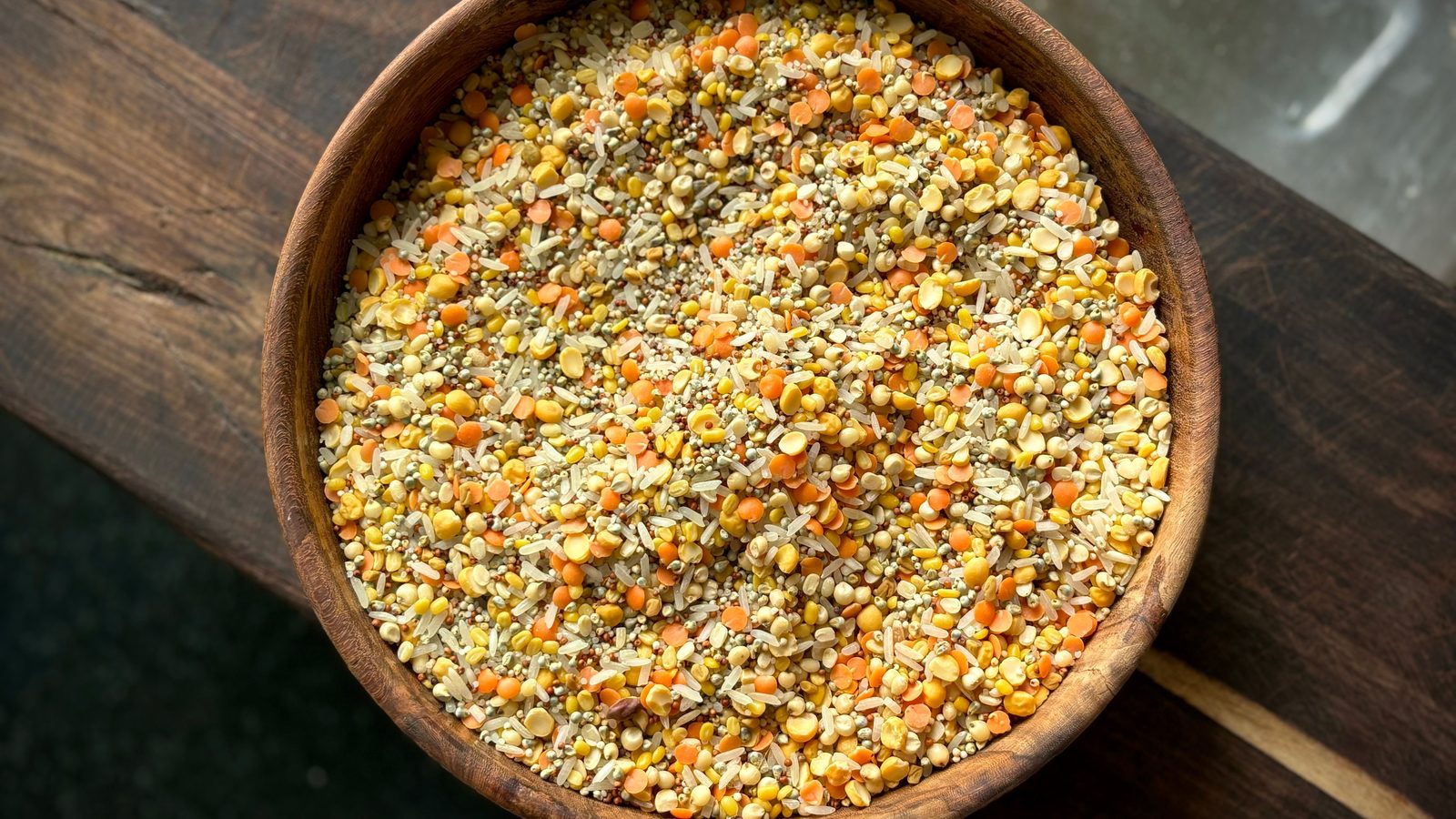
Quick answer: Bajra khichdi is pearl millet and moong dal cooked together in a pressure cooker, then finished with a cumin and ginger tadka. The step most people skip is soaking. Bajra stays hard and chewy unless you soak it for at least 1 hour, and one recipe soaks it overnight. Use about 6 to 8 times as much water as bajra by volume, cook for 3 to 5 whistles, let the pressure drop on its own, then mash it a little.
Key takeaways
- Soak the bajra. One recipe calls it mandatory and soaks for at least 1 hour, another soaks for 8 hours.
- Moong dal needs no soaking, or only 1 hour if you want it to cook faster.
- Two tested recipes use 3 to 4 cups of water for ½ cup bajra plus ⅓ to ½ cup dal, and 3 to 5 whistles.
- Bajra stays slightly chewy even when cooked well. Crushing it gives a smoother khichdi.
In this article, you’ll learn:
- Why bajra khichdi suits a winter dinner
- How long to soak, and why it matters
- Two recipes side by side: plain and with vegetables
- Water, whistles and texture fixes
- How to store and reheat it
Why Bajra Khichdi Works in Winter
Bajra, or pearl millet, shows up in a lot of Indian kitchens once the weather turns cold, as bajra roti, bajra raab and, on lazy evenings, bajra khichdi. It’s one pot, it’s filling, and it’s soft enough for kids and older family members.
Aahaaram Online calls it a recipe that’s especially popular in winter, because bajra is traditionally believed to generate heat in the body. The same recipe suggests people with high body heat eat it in moderation. Treat that as food tradition, not medical advice.
There’s also a broader reason to cook more millets. The UN Food and Agriculture Organization, which led the International Year of Millets, says millets can be an important part of a healthy diet and can grow on dry land with few inputs.
Soak the Bajra First
This is the step that decides whether your bajra khichdi turns creamy or stays like gravel.
Indian Veggie Delight says soaking the bajra for at least 1 hour is mandatory. Aahaaram Online goes further and soaks it in 2 cups of water for at least 8 hours, then drains it.
Why the difference? Bajra grains are hard, and a longer soak gives them more time to soften before they meet the cooker. If you remember in the morning, soak it before work. If you only remember at 6 pm, an hour still helps.
Moong dal is easier. Indian Veggie Delight doesn’t soak it at all. Aahaaram Online says soaking is optional, about 1 hour if you do, and that unsoaked dal just takes a little longer. For more on how long different dals need, see our guide to soaking dal.
Two Bajra Khichdi Recipes Compared
Here’s how the two recipes line up. They suit different evenings.
| Plain (Aahaaram Online) | With vegetables (Indian Veggie Delight) | |
|---|---|---|
| Bajra | ½ cup | ½ cup, broken |
| Moong dal | ⅓ cup | ½ cup split yellow |
| Vegetables | None | 2 cups mixed + 2 cups spinach |
| Water | 3 cups | 4 cups |
| Bajra soak | 8 hours | At least 1 hour |
| Whistles | 4 to 5 | 3 to 4 on medium flame |
| Ghee | ½ tsp | 1 tbsp (or oil) |
| Serves | 2 | 4 |
| Calories listed | 372 kcal per serving | 298 kcal per serving |
The vegetable version makes more food from the same half cup of bajra, which is why each serving has fewer calories. It’s also a good way to use up winter carrots, peas and cauliflower.
How to Make Bajra Khichdi in a Pressure Cooker
This method follows the plain recipe, with the vegetable option added. It serves 2, or 3 to 4 with vegetables.
- Soak. Wash ½ cup bajra and soak it for at least 1 hour, overnight if you can. Drain.
- Rinse the dal. Rinse ⅓ to ½ cup moong dal.
- Tadka first (vegetable version). Heat ghee in the cooker. Add cumin, a pinch of hing, ginger and a green chilli and fry for about 20 seconds. Add chopped carrot, peas or cauliflower and cook for a minute.
- Pressure cook. Add the bajra, dal, ¼ tsp turmeric, salt and 3 to 4 cups water. Cook for 3 to 5 whistles on medium flame.
- Let the pressure drop on its own. Don’t force it open.
- Mash and finish. Open the cooker and mash lightly with a ladle or whisk. In the vegetable version, stir in spinach and garam masala now. For the plain version, make a fresh tadka of cumin, chilli, ginger and hing in a little ghee, add the khichdi and simmer for about 5 minutes.
Serve hot with ghee, kadhi, dahi, papad or pickle. Not sure how many whistles your cooker needs? Our pressure cooker whistles guide explains why counts vary between cookers.
Bajra Khichdi Texture: Fixes for Common Problems
Bajra doesn’t behave like rice. Aahaaram Online points out that it stays grainy and chewy instead of soaking up water, and that it needs less water than a rice khichdi. Indian Veggie Delight describes the cooked result as slightly chewy too. So some bite is normal.
| Problem | Likely cause | Fix |
|---|---|---|
| Grains hard in the centre | Bajra not soaked, or soaked too briefly | Soak longer next time. Now, add ½ cup water and cook 1 to 2 more whistles |
| Too chewy overall | Whole grains | Crush the bajra lightly before or after soaking |
| Too dry | Not enough water | Stir in ½ cup hot water and simmer for a minute |
| Too watery | Too much water | Cook uncovered on low heat, stirring |
| Turns stiff on the plate | Normal, it thickens as it rests | Add a little hot water before serving |
| Dal mushy, bajra hard | Dal cooks much faster than bajra | Soak only the bajra, or cook the bajra for a couple of whistles first, then add the dal |
Indian Veggie Delight also suggests cutting vegetables into large chunks, because small pieces turn to mush under pressure.
Is Bajra Khichdi a Healthy Dinner?
It’s a sensible one. You get a whole grain plus a dal in one bowl, and the vegetable version adds fibre and colour. The recipes above use very little ghee, ½ teaspoon in the plain version and 1 tablespoon for 4 servings in the other.
Keep the portion and the extras in mind. A big spoon of ghee on top, papad and pickle add up quickly. If you want a richer winter treat, save it for something like moong dal halwa, and keep the khichdi light.
If you have a medical condition that affects what you eat, ask your doctor or dietitian how millets fit into your diet.
Storing and Reheating Bajra Khichdi
Bajra khichdi thickens a lot as it cools. Indian Veggie Delight says leftovers keep in an airtight box in the fridge for up to 2 days. That matches UK Food Standards Agency chilling guidance, which says to get cooked food into the fridge within one to two hours, keep the fridge between 0 and 5°C, and eat leftovers within 48 hours.
To reheat, add a few spoons of water and warm it on the stove or in the microwave, stirring until it loosens.
Frequently Asked Questions About Bajra Khichdi
Can I make bajra khichdi without soaking?
You can try, but the grains will likely stay hard. Both recipes soak the bajra, for at least 1 hour or up to 8 hours. If you forget, cook it longer and add more water.
Can I use bajra flour instead of whole bajra?
Not for khichdi. Flour turns into a porridge like raab. For khichdi you want whole or broken bajra grains.
Can I add rice to bajra khichdi?
Yes, some families do. Rice cooks faster than bajra, so add it with the dal and keep an eye on the water.
Is bajra khichdi good for kids?
It’s soft and mild, so many kids eat it happily. Mash it a little more for small children and skip the green chilli.
One Pot for a Cold Evening
Bajra khichdi asks for one bit of planning: soak the grain. After that, it’s a cooker, a few whistles and a quick tadka. Make the plain version when you want something simple, or load it with winter vegetables to stretch it to four plates.
Save this for the next cold night, share it with someone who has a bag of bajra in the cupboard, and follow our WhatsApp channel for more winter recipes.